
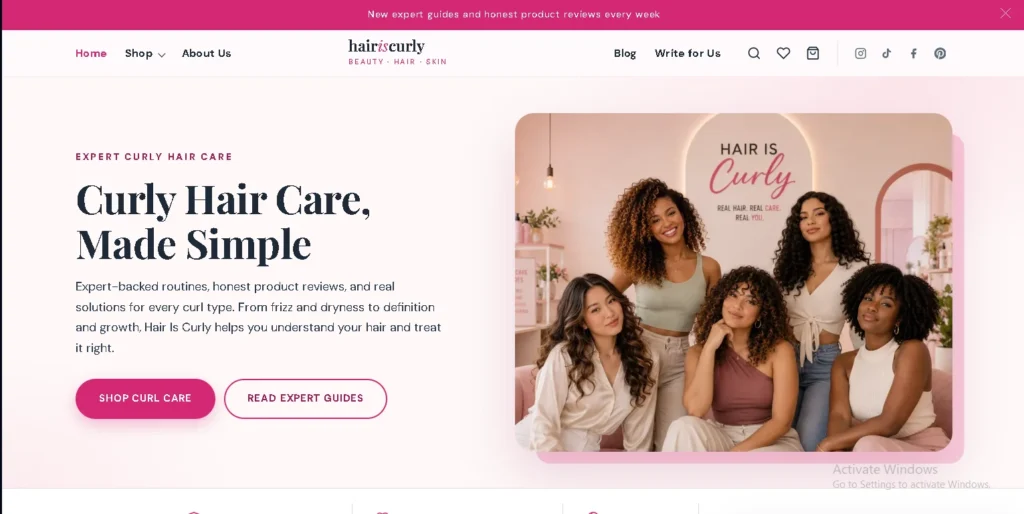
Hair and beauty is one of the most crowded content categories on the web. The established sites in it have years of authority and budgets to match, and a newer site that tries to beat them head on for the obvious queries will spend a long time losing quietly.
HairIsCurly went at it from a different angle, and the angle turned out to matter more than the effort.
The route in was image search
Hair care is a visual subject. People search for what a curl pattern looks like, what a product does to it, what a style should look like before they commit to it. Those searches often resolve in Google Images rather than in the standard blue links, and image results are far less contested than the article results sitting next to them.
Most content sites treat images as decoration: a stock photo dropped in to break up text, named whatever the camera called it, with alt text written to satisfy a plugin. Treated as a channel instead, they behave completely differently.
The site has since passed 1.1 million image search impressions in Google Search Console, across a library of more than fifty published articles.
What the build had to support
A content library that grows to dozens of articles has different needs from a five page brochure site. The structure has to hold up as it fills.
- A custom theme rather than a page builder. Every article loads the same lean template, so page weight does not creep upward as the library grows.
- Images treated as content. Named for what they show, sized correctly, with dimensions set so nothing shifts as the page loads, and alt text written for a reader who cannot see the image rather than for a crawler.
- WooCommerce alongside the content, so the commercial pages and the editorial pages share one structure instead of feeling like two different websites bolted together.
- Internal linking built deliberately. New articles connect to the existing library on publication, rather than sitting alone waiting to be found.
What the numbers did
Across the most recent measured period, web search performance moved in the right direction on every measure that matters:
- Clicks rose from 272 to 374, an increase of 37.5 percent
- Impressions rose from 42,179 to 53,252, an increase of 26.2 percent
- Average position improved from 14.17 to 13.25
The average position movement is the one worth pausing on. Under a point of improvement sounds like nothing, but the gap between the bottom of page one and the top of page two is where click through rate changes fastest. Impressions climbing at the same time means the site is being shown for more queries, not simply being shown more often for the same ones.
Image impressions and web impressions also do different jobs. Image search brings people who are still deciding. Web search brings people who have decided and are looking for an answer. A site earning both is being found at two different points of the same journey.
What transfers to other sites
The specific tactic does not transfer everywhere. Image search works here because the subject is visual and the searches genuinely are. A B2B software site will not get the same return from renaming its screenshots.
What does transfer is the reasoning. In a category you cannot win head on, find the surface where the competition has been lazy, and be deliberate there. For a visual niche that is image search. For a service business it is often the specific, unglamorous queries that the big directories answer badly. The work is identifying which one applies to you before spending anything, which is exactly what an SEO audit is for.
If you are building a content library that has to compete against much larger sites, the SEO and content pilot is the closest equivalent to how this site was grown.